AI Avatar Chat

AI Avatar Chat — independent reviews, comparisons, pricing and step-by-step guides on Aizhi.

  • Human–robot interaction

    Human–robot interaction

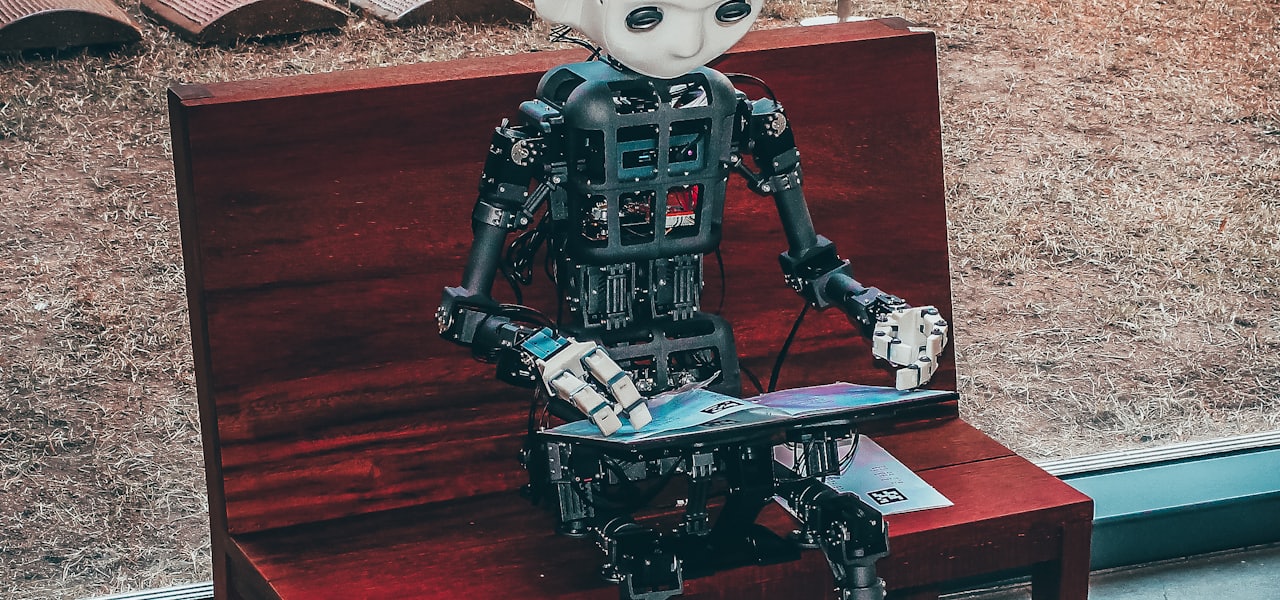
    Human–robot interaction (HRI) is the study of interactions between humans and robots. Human–robot interaction is a multidisciplinary field with contributions from human–computer interaction, artificial intelligence, robotics, natural language processing, design, psychology and philosophy. A subfield known as physical human–robot interaction (pHRI) has tended to focus on device design to enable people to safely interact with robotic systems. == Origins == Human–robot interaction has been a topic of both science fiction and academic speculation even before any robots existed. Because much of active HRI development depends on natural language processing, many aspects of HRI are continuations of human communications, a field of research which is much older than robotics. The origin of HRI as a discrete problem was stated by 20th-century author Isaac Asimov in 1941, in his novel I, Robot. Asimov coined Three Laws of Robotics, namely: A robot may not injure a human being or, through inaction, allow a human being to come to harm. A robot must obey the orders given it by human beings except where such orders would conflict with the First Law. A robot must protect its own existence as long as such protection does not conflict with the First or Second Laws. These three laws provide an overview of the goals engineers and researchers hold for safety in the HRI field, although the fields of robot ethics and machine ethics are more complex than these three principles. However, generally human–robot interaction prioritizes the safety of humans that interact with potentially dangerous robotics equipment. Solutions to this problem range from the philosophical approach of treating robots as ethical agents (individuals with moral agency), to the practical approach of creating safety zones. These safety zones use technologies such as lidar to detect human presence or physical barriers to protect humans by preventing any contact between machine and operator. Although initially robots in the human–robot interaction field required some human intervention to function, research has expanded this to the extent that fully autonomous systems are now far more common than in the early 2000s. Autonomous systems include from simultaneous localization and mapping systems which provide intelligent robot movement to natural-language processing and natural-language generation systems which allow for natural, human-esque interaction which meet well-defined psychological benchmarks. Anthropomorphic robots (machines which imitate human body structure) are better described by the biomimetics field, but overlap with HRI in many research applications. Examples of robots which demonstrate this trend include Willow Garage's PR2 robot, the NASA Robonaut, and Honda ASIMO. However, robots in the human–robot interaction field are not limited to human-like robots: Paro and Kismet are both robots designed to elicit emotional response from humans, and so fall into the category of human–robot interaction. Goals in HRI range from industrial manufacturing through Cobots, medical technology through rehabilitation, autism intervention, and elder care devices, entertainment, human augmentation, and human convenience. Future research therefore covers a wide range of fields, much of which focuses on assistive robotics, robot-assisted search-and-rescue, and space exploration. == The goal of friendly human–robot interactions == Robots are artificial agents with capacities of perception and action in the physical world often referred by researchers as workspace. Their use has been generalized in factories but nowadays they tend to be found in the most technologically advanced societies in such critical domains as search and rescue, military battle, mine and bomb detection, scientific exploration, law enforcement, entertainment and hospital care. These new domains of applications imply a closer interaction with the user, sharing the workspace but also goals in terms of task achievement. The subfield of physical human–robot interaction (pHRI) has largely focused on device design to enable people to safely interact with robotic systems but is increasingly developing algorithmic approaches in an attempt to support fluent and expressive interactions between humans and robotic systems. With the advance in AI, the research is focusing on one part towards the safest physical interaction but also on a socially correct interaction, dependent on cultural criteria. The goal is to build an intuitive, and easy communication with the robot through speech, gestures, and facial expressions. Kerstin Dautenhahn refers to friendly Human–robot interaction as "Robotiquette" defining it as the "social rules for robot behaviour (a 'robotiquette') that is comfortable and acceptable to humans" The robot has to adapt itself to our way of expressing desires and orders and not the contrary. But every day environments such as homes have much more complex social rules than those implied by factories or even military environments. Thus, the robot needs perceiving and understanding capacities to build dynamic models of its surroundings. It needs to categorize objects, recognize and locate humans and further recognize their emotions. The need for dynamic capacities pushes forward every sub-field of robotics. Furthermore, by understanding and perceiving social cues, robots can enable collaborative scenarios with humans. For example, with the rapid rise of personal fabrication machines such as desktop 3D printers, laser cutters, etc., entering our homes, scenarios may arise where robots can collaboratively share control, co-ordinate and achieve tasks together. Industrial robots have already been integrated into industrial assembly lines and are collaboratively working with humans. The social impact of such robots have been studied and has indicated that workers still treat robots and social entities, rely on social cues to understand and work together. On the other end of HRI research the cognitive modelling of the "relationship" between human and the robots benefits the psychologists and robotic researchers the user study are often of interests on both sides. This research endeavours part of human society. For effective human – humanoid robot interaction numerous communication skills and related features should be implemented in the design of such artificial agents/systems. == General HRI research == HRI research spans a wide range of fields, some general to the nature of HRI. === Methods for perceiving humans === Methods for perceiving humans in the environment are based on sensor information. Research on sensing components and software led by Microsoft provide useful results for extracting the human kinematics (see Kinect). An example of older technique is to use colour information for example the fact that for light skinned people the hands are lighter than the clothes worn. In any case a human modelled a priori can then be fitted to the sensor data. The robot builds or has (depending on the level of autonomy the robot has) a 3D mapping of its surroundings to which is assigned the humans locations. Most methods intend to build a 3D model through vision of the environment. The proprioception sensors permit the robot to have information over its own state. This information is relative to a reference. Theories of proxemics may be used to perceive and plan around a person's personal space. A speech recognition system is used to interpret human desires or commands. By combining the information inferred by proprioception, sensor and speech the human position and state (standing, seated). In this matter, natural-language processing is concerned with the interactions between computers and human (natural) languages, in particular how to program computers to process and analyze large amounts of natural-language data. For instance, neural-network architectures and learning algorithms that can be applied to various natural-language processing tasks including part-of-speech tagging, chunking, named-entity recognition, and semantic role labeling. === Methods for motion planning === Motion planning in dynamic environments is a challenge that can at the moment only be achieved for robots with 3 to 10 degrees of freedom. Humanoid robots or even 2 armed robots, which can have up to 40 degrees of freedom, are unsuited for dynamic environments with today's technology. However lower-dimensional robots can use the potential field method to compute trajectories which avoid collisions with humans. === Cognitive models and theory of mind === Humans exhibit negative social and emotional responses as well as decreased trust toward some robots that closely, but imperfectly, resemble humans; this phenomenon has been termed the "Uncanny Valley". However recent research in telepresence robots has established that mimicking human body postures and expressive gestures has made the robots likeable and engaging in a remote setting. Further, the presence o

    Read more →
  • Is an AI Art Generator Worth It in 2026?

    Is an AI Art Generator Worth It in 2026?

    Curious about the best AI art generator? An AI art generator is software that uses machine learning to help you get more done — it combines speed, accuracy, and an interface that just works. Hands-on testing shows real-world results vary, so a short free trial is the smartest way to decide. Whether you are a beginner or a pro, the right AI art generator slots into your workflow and pays for itself fast. Read on for hands-on impressions, pricing tiers, and the standout features that matter.

    Read more →
  • RAMnets

    RAMnets

    RAMnets is one of the oldest practical neurally inspired classification algorithms. The RAMnets is also known as a type of "n-tuple recognition method" or "weightless neural network". == Algorithm == Consider (let us say N) sets of n distinct bit locations are selected randomly. These are the n-tuples. The restriction of a pattern to an n-tuple can be regarded as an n-bit number which, together with the identity of the n-tuple, constitutes a `feature' of the pattern. The standard n-tuple recognizer operates simply as follows: A pattern is classified as belonging to the class for which it has the most features in common with at least one training pattern of that class. This is the Θ {\displaystyle \Theta } = 0 case of a more general rule whereby the class assigned to unclassified pattern u is a c r g m a x ( ∑ i = 1 N Θ ( ∑ v ∈ D c δ ( α i ( u ) , α i ( v ) ) ) ) {\displaystyle {\begin{aligned}{\underset {c}{a}}rgmax(\sum _{i=1}^{N}\Theta (\sum _{v\in D_{c}}\delta (\alpha _{i}(u),\alpha _{i}(v))))\end{aligned}}} where Dc is the set of training patterns in class c, Θ ( x ) {\displaystyle \Theta (x)} = x for 0 ≤ x ≤ θ {\displaystyle 0\leq x\leq \theta } , Θ ( x ) = θ {\displaystyle \Theta (x)=\theta } for x ≥ θ {\displaystyle x\geq \theta } , δ i , j {\displaystyle \delta _{i,j}} is the Kronecker delta( δ i , j {\displaystyle \delta _{i,j}} =1 if i=j and 0 otherwise.)and ( α i ( u ) ) {\displaystyle (\alpha _{i}(u))} is the ith feature of the pattern u: ∑ j = 0 n − 1 u η i ( j ) 2 j {\displaystyle \sum _{j=0}^{n-1}u_{\eta }i(j)2^{j}} Here uk is the kth bit of u and u η i ( j ) {\displaystyle u_{\eta }i(j)} is the jth bit location of the ith n-tuple. With C classes to distinguish, the system can be implemented as a network of NC nodes, each of which is a random access memory (RAM); hence the term RAMnet. The memory content m c i α {\displaystyle m_{ci\alpha }} at address α {\displaystyle \alpha } of the ith node allocated to class c is set to m c i α {\displaystyle m_{ci\alpha }} = Θ ( ∑ v ∈ D c δ ( α , α i ( v ) ) ) {\displaystyle \Theta (\sum _{v\in D_{c}}\delta (\alpha ,\alpha _{i}(v)))} In the usual θ {\displaystyle \theta } = 1 case, the 1-bit content of m c i α {\displaystyle m_{ci\alpha }} is set if any pattern of Dc has feature α {\displaystyle \alpha } and unset otherwise. Recognition is accomplished by summing the contents of the nodes of each class at the addresses given by the features of the unclassified pattern. That is, pattern u is assigned to class a c r g m a x ( ∑ i = 1 N m c i α ( u ) ) {\displaystyle {\begin{aligned}{\underset {c}{a}}rgmax(\sum _{i=1}^{N}m_{ci\alpha }(u))\end{aligned}}} == RAM-discriminators and WiSARD == The RAMnets formed the basis of a commercial product known as WiSARD (Wilkie, Stonham and Aleksander Recognition Device) was the first artificial neural network machine to be patented. A RAM-discriminator consists of a set of X one-bit word RAMs with n inputs and a summing device (Σ). Any such RAM-discriminator can receive a binary pattern of X⋅n bits as input. The RAM input lines are connected to the input pattern by means of a biunivocal pseudo-random mapping. The summing device enables this network of RAMs to exhibit – just like other ANN models based on synaptic weights – generalization and noise tolerance. In order to train the discriminator one has to set all RAM memory locations to 0 and choose a training set formed by binary patterns of X⋅n bits. For each training pattern, a 1 is stored in the memory location of each RAM addressed by this input pattern. Once the training of patterns is completed, RAM memory contents will be set to a certain number of 0's and 1's. The information stored by the RAM during the training phase is used to deal with previous unseen patterns. When one of these is given as input, the RAM memory contents addressed by the input pattern are read and summed by Σ. The number r thus obtained, which is called the discriminator response, is equal to the number of RAMs that output 1. r reaches the maximum X if the input belongs to the training set. r is equal to 0 if no n-bit component of the input pattern appears in the training set (not a single RAM outputs 1). Intermediate values of r express a kind of “similarity measure” of the input pattern with respect to the patterns in the training set. A system formed by various RAM-discriminators is called WiSARD. Each RAM-discriminator is trained on a particular class of patterns, and classification by the multi-discriminator system is performed in the following way. When a pattern is given as input, each RAM-discriminator gives a response to that input. The various responses are evaluated by an algorithm which compares them and computes the relative confidence c of the highest response (e.g., the difference d between the highest response and the second highest response, divided by the highest response). A schematic representation of a RAM-discriminator and a 10 RAM-discriminator WiSARD is shown in Figure 1.

    Read more →
  • Top 10 AI Subtitle Generators Compared (2026)

    Top 10 AI Subtitle Generators Compared (2026)

    Curious about the best AI subtitle generator? An AI subtitle generator is software that uses machine learning to help you get more done — it combines speed, accuracy, and an interface that just works. Hands-on testing shows real-world results vary, so a short free trial is the smartest way to decide. Whether you are a beginner or a pro, the right AI subtitle generator slots into your workflow and pays for itself fast. Read on for hands-on impressions, pricing tiers, and the standout features that matter.

    Read more →
  • Color image pipeline

    Color image pipeline

    An image pipeline or video pipeline is the set of components commonly used between an image source (such as a camera, a scanner, or the rendering engine in a computer game), and an image renderer (such as a television set, a computer screen, a computer printer or cinema screen), or for performing any intermediate digital image processing consisting of two or more separate processing blocks. An image/video pipeline may be implemented as computer software, in a digital signal processor, on an FPGA, or as fixed-function ASIC. In addition, analog circuits can be used to do many of the same functions. Typical components include image sensor corrections (including debayering or applying a Bayer filter), noise reduction, image scaling, gamma correction, image enhancement, colorspace conversion (between formats such as RGB, YUV or YCbCr), chroma subsampling, framerate conversion, image compression/video compression (such as JPEG), and computer data storage/data transmission. Typical goals of an imaging pipeline may be perceptually pleasing end-results, colorimetric precision, a high degree of flexibility, low cost/low CPU utilization/long battery life, or reduction in bandwidth/file size. Some functions may be algorithmically linear. Mathematically, those elements can be connected in any order without changing the end-result. As digital computers use a finite approximation to numerical computing, this is in practice not true. Other elements may be non-linear or time-variant. For both cases, there is often one or a few sequences of components that makes sense for optimum precision and minimum hardware-cost/CPU-load.

    Read more →
  • How to Choose an AI Pair Programmer

    How to Choose an AI Pair Programmer

    In search of the best AI pair programmer? An AI pair programmer is software that uses machine learning to help you get more done — it turns a rough idea into a polished result in seconds. When choosing one, weigh output quality, pricing, export formats, and how well it fits the tools you already use. Whether you are a beginner or a pro, the right AI pair programmer slots into your workflow and pays for itself fast. We tested the leading options and ranked them by quality, value, and ease of use.

    Read more →
  • Liz Liddy

    Liz Liddy

    Elizabeth DuRoss Liddy (May 12, 1944 – August 21, 2025) was an American computer scientist and academic who was professor of information science and dean of the Syracuse University School of Information Studies. She was a pioneer in the field of natural language processing. == Early life and education == Liddy was born in Dayton, Ohio, on May 14, 1944, and grew up in Utica, New York. She was one of five children, all of whom worked in her father's family business. Liddy attended St. Francis DeSalle High School, where she was awarded a Regent's Scholarship, and eventually attended Daemen College. She was literary editor of her high school year book and edited a literary magazine during her time at college. At Daemen College Liddy studied English language and literature. After graduating Liddy remained in New York, where she volunteered in an elementary school library. She joined the Syracuse University School of Information Studies in 1983, where she started a graduate program in library science. She worked as a faculty librarian at Onondaga Community College whilst earning her degree. Here Liddy worked as a Visiting assistant professor, whilst completing her doctorate part-time in information transfer. Her dissertation research involved natural language processing, a computerized approach to analyzing text. She was hired to the faculty at Syracuse University whilst completing her PhD. == Research and career == In 1994 Liddy was the founding President of TextWise, a semantics-based search engine. The first product she developed was called Document Retrieval Using Linguistic Knowledge (DR-LINK). She left TextWise in 1999, after growing the number of employees to over 50. She started the Syracuse University Center for Natural Language Processing in 1999, and was honored with the university's Outstanding Alumni Award the following year. Liddy was appointed Dean of the School of Information Studies (iSchool) in 2008, and held the position for over ten years. She temporarily left the role in 2015. The school was transformed under her leadership, increasing the enrollment of students by over 70% and launching a graduate certificate in data science. She raised over $20 million to support research and development at Syracuse University. She chaired the iSchool Organization, which connects information science schools all over the world, from 2012 to 2014. Liddy worked to increase the representation of women at the iSchool, through initiatives such as the IT Girls Overnight Retreat – an annual weekend to introduce high school girls to Information Technology. She improved the career development programs of students at Syracuse University, increasing student employment to almost 100% post graduation. Liddy retired as Dean of the iSchool in 2019. === Selected innovations === US 6026388, Liddy, Elizabeth D., "User interface and other enhancements for natural language information retrieval system and method", published August 16, 1995, issued February 15, 2000 US 5963940, Liddy, Elizabeth D., "Natural language information retrieval system and method", published August 16, 1995, issued October 5, 1999 US 6006221, Liddy, Elizabeth D., "Multilingual document retrieval system and method using semantic vector matching", published August 16, 1995, issued December 21, 1999 == Personal life and death == Liddy was married shortly after graduating Daemen College in 1966. She had three children. Liddy died in Charlotte, North Carolina, on August 21, 2025, at the age of 81.

    Read more →
  • The Best Free AI Blog Writer for Beginners

    The Best Free AI Blog Writer for Beginners

    Looking for the best AI blog writer? An AI blog writer is software that uses machine learning to help you get more done — it can save you hours every week by automating repetitive work. Most options offer a generous free tier, with paid plans unlocking higher limits, faster processing, and team features. Whether you are a beginner or a pro, the right AI blog writer slots into your workflow and pays for itself fast. Read on for hands-on impressions, pricing tiers, and the standout features that matter.

    Read more →
  • Resilience week

    Resilience week

    Resilience week is an annual symposium established to enable cross-disciplinary and role based discussions to advance strategies and research that engenders resilience in critical infrastructure systems and communities. Damaging storms, cyber attack and the interconnection of critical infrastructure systems can lead to cascading events that not only affect local but also across regions. However, many of these interdependencies are not easily recognized and obscure and complicate the mitigation of risk. The purpose of the symposia series is hence to facilitate best practice in managing critical infrastructure risks, by bringing together businesses, government and researchers. == Background == Originally organized in 2008 as a focus on the new research area of resilient control systems, including the disciplinary areas of control system, cyber-security, cognitive psychology and any number of critical infrastructure domains. Resilience has long been recognized as an area that requires not only the contributions of multiple disciplines or multidisciplinary participation, but interdisciplinary interaction where there is a common language and familiarity of the contributors to what other disciplines (and roles) contribute. The resulting interactions developed by Resilience Week and associated activities are intended to culture this sharing environment as a safe zone for inclusion; more importantly, an environment that lends to developing the new science and practice. As the attributes of resilience are complex, the contributions and topics for the event have included both the disciplinary and the project considerations, in keynotes, panels and research presentations. Keynotes have included senior leadership in the Department of Energy, Department of Defense, Department of Homeland Security, the National Science Foundation, and other agencies in addition to National Academy and professional organization fellows and senior industry leaders. Project panels and research presentations include emergent topics in resilience to climate change, cyber attack, damaging storms and the energy assurance. Topics Areas of focus have included: Control Systems Cyber Systems Cognitive Systems Communications Systems Communities and Infrastructure Project Focus Areas have included: Dependencies and Interdependencies Cyber Resilience for Operating Technology Commercializing Research and Development Building Critical Infrastructure Resilience through Distributed Energy Resources Energy Equity and Community Resilience Proceedings are developed for each year of the event, documenting the diversity of the research and engagements within these topical areas. == Impacts for the future == Since its inception, the Resilience Week community has evolved from one that primarily included only university researchers to one that includes many government laboratories, universities and private industries in the US and internationally. This type of collaboration forms a feedback loop that informs the research with the current needs and hones best practices. The future of the event is to further advance discussions that advance investment, recognize priorities and expedite technologies and tools to proactively address our energy future, in light of the natural and manmade challenges, and rationalizing the complex relationships that exist in critical infrastructure.

    Read more →
  • Maximum-entropy Markov model

    Maximum-entropy Markov model

    In statistics, a maximum-entropy Markov model (MEMM), or conditional Markov model (CMM), is a graphical model for sequence labeling that combines features of hidden Markov models (HMMs) and maximum entropy (MaxEnt) models. An MEMM is a discriminative model that extends a standard maximum entropy classifier by assuming that the unknown values to be learnt are connected in a Markov chain rather than being conditionally independent of each other. MEMMs find applications in natural language processing, specifically in part-of-speech tagging and information extraction. == Model == Suppose we have a sequence of observations O 1 , … , O n {\displaystyle O_{1},\dots ,O_{n}} that we seek to tag with the labels S 1 , … , S n {\displaystyle S_{1},\dots ,S_{n}} that maximize the conditional probability P ( S 1 , … , S n ∣ O 1 , … , O n ) {\displaystyle P(S_{1},\dots ,S_{n}\mid O_{1},\dots ,O_{n})} . In a MEMM, this probability is factored into Markov transition probabilities, where the probability of transitioning to a particular label depends only on the observation at that position and the previous position's label: P ( S 1 , … , S n ∣ O 1 , … , O n ) = ∏ t = 1 n P ( S t ∣ S t − 1 , O t ) . {\displaystyle P(S_{1},\dots ,S_{n}\mid O_{1},\dots ,O_{n})=\prod _{t=1}^{n}P(S_{t}\mid S_{t-1},O_{t}).} Each of these transition probabilities comes from the same general distribution P ( s ∣ s ′ , o ) {\displaystyle P(s\mid s',o)} . For each possible label value of the previous label s ′ {\displaystyle s'} , the probability of a certain label s {\displaystyle s} is modeled in the same way as a maximum entropy classifier: P ( s ∣ s ′ , o ) = P s ′ ( s ∣ o ) = 1 Z ( o , s ′ ) exp ⁡ ( ∑ a λ a f a ( o , s ) ) . {\displaystyle P(s\mid s',o)=P_{s'}(s\mid o)={\frac {1}{Z(o,s')}}\exp \left(\sum _{a}\lambda _{a}f_{a}(o,s)\right).} Here, the f a ( o , s ) {\displaystyle f_{a}(o,s)} are real-valued or categorical feature-functions, and Z ( o , s ′ ) {\displaystyle Z(o,s')} is a normalization term ensuring that the distribution sums to one. This form for the distribution corresponds to the maximum entropy probability distribution satisfying the constraint that the empirical expectation for the feature is equal to the expectation given the model: E e ⁡ [ f a ( o , s ) ] = E p ⁡ [ f a ( o , s ) ] for all a . {\displaystyle \operatorname {E} _{e}\left[f_{a}(o,s)\right]=\operatorname {E} _{p}\left[f_{a}(o,s)\right]\quad {\text{ for all }}a.} The parameters λ a {\displaystyle \lambda _{a}} can be estimated using generalized iterative scaling. Furthermore, a variant of the Baum–Welch algorithm, which is used for training HMMs, can be used to estimate parameters when training data has incomplete or missing labels. The optimal state sequence S 1 , … , S n {\displaystyle S_{1},\dots ,S_{n}} can be found using a very similar Viterbi algorithm to the one used for HMMs. The dynamic program uses the forward probability: α t + 1 ( s ) = ∑ s ′ ∈ S α t ( s ′ ) P s ′ ( s ∣ o t + 1 ) . {\displaystyle \alpha _{t+1}(s)=\sum _{s'\in S}\alpha _{t}(s')P_{s'}(s\mid o_{t+1}).} == Strengths and weaknesses == An advantage of MEMMs rather than HMMs for sequence tagging is that they offer increased freedom in choosing features to represent observations. In sequence tagging situations, it is useful to use domain knowledge to design special-purpose features. In the original paper introducing MEMMs, the authors write that "when trying to extract previously unseen company names from a newswire article, the identity of a word alone is not very predictive; however, knowing that the word is capitalized, that is a noun, that it is used in an appositive, and that it appears near the top of the article would all be quite predictive (in conjunction with the context provided by the state-transition structure)." Useful sequence tagging features, such as these, are often non-independent. Maximum entropy models do not assume independence between features, but generative observation models used in HMMs do. Therefore, MEMMs allow the user to specify many correlated, but informative features. Another advantage of MEMMs versus HMMs and conditional random fields (CRFs) is that training can be considerably more efficient. In HMMs and CRFs, one needs to use some version of the forward–backward algorithm as an inner loop in training. However, in MEMMs, estimating the parameters of the maximum-entropy distributions used for the transition probabilities can be done for each transition distribution in isolation. A drawback of MEMMs is that they potentially suffer from the "label bias problem," where states with low-entropy transition distributions "effectively ignore their observations." Conditional random fields were designed to overcome this weakness, which had already been recognised in the context of neural network-based Markov models in the early 1990s. Another source of label bias is that training is always done with respect to known previous tags, so the model struggles at test time when there is uncertainty in the previous tag.

    Read more →
  • HFST

    HFST

    Helsinki Finite-State Technology (HFST) is a computer programming library and set of utilities for natural language processing with finite-state automata and finite-state transducers. It is free and open-source software, released under a mix of the GNU General Public License version 3 (GPLv3) and the Apache License. == Features == The library functions as an interchanging interface to multiple backends, such as OpenFST, foma and SFST. The utilities comprise various compilers, such as hfst-twolc (a compiler for morphological two-level rules), hfst-lexc (a compiler for lexicon definitions) and hfst-regexp2fst (a regular expression compiler). Functions from Xerox's proprietary scripting language xfst is duplicated in hfst-xfst, and the pattern matching utility pmatch in hfst-pmatch, which goes beyond the finite-state formalism in having recursive transition networks (RTNs). The library and utilities are written in C++, with an interface to the library in Python and a utility for looking up results from transducers ported to Java and Python. Transducers in HFST may incorporate weights depending on the backend. For performing FST operations, this is currently only possible via the OpenFST backend. HFST provides two native backends, one designed for fast lookup (hfst-optimized-lookup), the other for format interchange. Both of them can be weighted. == Uses == HFST has been used for writing various linguistic tools, such as spell-checkers, hyphenators, and morphologies. Morphological dictionaries written in other formalisms have also been converted to HFST's formats.

    Read more →
  • Transfer-based machine translation

    Transfer-based machine translation

    Transfer-based machine translation is a type of machine translation (MT). It is currently one of the most widely used methods of machine translation. In contrast to the simpler direct model of MT, transfer MT breaks translation into three steps: analysis of the source language text to determine its grammatical structure, transfer of the resulting structure to a structure suitable for generating text in the target language, and finally generation of this text. Transfer-based MT systems are thus capable of using knowledge of the source and target languages. == Design == Both transfer-based and interlingua-based machine translation have the same idea: to make a translation it is necessary to have an intermediate representation that captures the "meaning" of the original sentence in order to generate the correct translation. In interlingua-based MT this intermediate representation must be independent of the languages in question, whereas in transfer-based MT, it has some dependence on the language pair involved. The way in which transfer-based machine translation systems work varies substantially, but in general they follow the same pattern: they apply sets of linguistic rules which are defined as correspondences between the structure of the source language and that of the target language. The first stage involves analysing the input text for morphology and syntax (and sometimes semantics) to create an internal representation. The translation is generated from this representation using both bilingual dictionaries and grammatical rules. It is possible with this translation strategy to obtain fairly high quality translations, with accuracy in the region of 90% (although this is highly dependent on the language pair in question, for example the distance between the two). == Operation == In a rule-based machine translation system the original text is first analysed morphologically and syntactically in order to obtain a syntactic representation. This representation can then be refined to a more abstract level putting emphasis on the parts relevant for translation and ignoring other types of information. The transfer process then converts this final representation (still in the original language) to a representation of the same level of abstraction in the target language. These two representations are referred to as "intermediate" representations. From the target language representation, the stages are then applied in reverse. == Analysis and transformation == Various methods of analysis and transformation can be used before obtaining the final result. Along with these statistical approaches may be augmented generating hybrid systems. The methods which are chosen and the emphasis depends largely on the design of the system, however, most systems include at least the following stages: Morphological analysis. Surface forms of the input text are classified as to part-of-speech (e.g. noun, verb, etc.) and sub-category (number, gender, tense, etc.). All of the possible "analyses" for each surface form are typically made output at this stage, along with the lemma of the word. Lexical categorisation. In any given text some of the words may have more than one meaning, causing ambiguity in analysis. Lexical categorisation looks at the context of a word to try to determine the correct meaning in the context of the input. This can involve part-of-speech tagging and word sense disambiguation. Lexical transfer. This is basically dictionary translation; the source language lemma (perhaps with sense information) is looked up in a bilingual dictionary and the translation is chosen. Structural transfer. While the previous stages deal with words, this stage deals with larger constituents, for example phrases and chunks. Typical features of this stage include concordance of gender and number, and re-ordering of words or phrases. Morphological generation. From the output of the structural transfer stage, the target language surface forms are generated. == Transfer types == One of the main features of transfer-based machine translation systems is a phase that "transfers" an intermediate representation of the text in the original language to an intermediate representation of text in the target language. This can work at one of two levels of linguistic analysis, or somewhere in between. The levels are: Superficial transfer (or syntactic). This level is characterised by transferring "syntactic structures" between the source and target languages. It is suitable for languages in the same family or of the same type, for example in the Romance languages between Spanish, Catalan, French, Italian, etc. Deep transfer (or semantic). This level constructs a semantic representation that is dependent on the source language. This representation can consist of a series of structures which represent the meaning. In these transfer systems predicates are typically produced. The translation also typically requires structural transfer. This level is used to translate between more distantly related languages (e.g. Spanish-English or Spanish-Basque, etc.)

    Read more →
  • QF-Test

    QF-Test

    QF-Test from Quality First Software is a cross-platform software tool for automated testing of programs via the graphical user interface (GUI) test automation). The program is specialized on (Java/Swing, Standard Widget Toolkit (SWT), Eclipse plug-ins and rich client platform (RCP) applications, ULC and JavaFX) cross-web browser test automation of static and dynamic web applications (HTML and web frameworks like Angular, Ext JS, Fluent UI React, Google Web Toolkit (GWT), jQuery UI, jQueryEasyUI Remote Application Platform (RAP), Qooxdoo, RichFaces, Vaadin, React, Smart GWT, Vue.js, ICEfaces and ZK). Version 4.1 added support for macOS and the Apple Safari and Microsoft Edge browsers via the Selenium WebDriver. Representational State Transfer (RESTful) web service testing. From version 5.0, Windows applications can also be tested (classic Win32 applications, .NET framework applications (often developed in C#) based on Windows Presentation Foundation (WPF) or Windows Forms, Windows apps and Universal Windows Platform (UWP) applications using Extensible Application Markup Language (XAML) controls) and modern C++ applications (such as Qt applications). Version 5.3 added support for the Chrome DevTools protocol, which allows browsers to be controlled using CDP drivers. Since then, mobile testing for iOS and Android, accessibility testing of web applications and SmartID, a new approach for more flexible and robust component recognition, have been introduced. Powerful enhancements such as WebAPI testing and AI-assisted validation complement the test automation tool. == Overview == QF-Test (the successor of qftestJUI, available since 2001) enables regression and load testing and runs on Windows, Unix and macOS. It is mainly used commercially by testers, developers or business analysts (modelling, low code approaches) with or without programming knowledge as part of software Quality Assurance. Since December 2008, a webtest add-on is available which allows test automation of browser-based GUIs (such as Internet Explorer, Mozilla Firefox, Google Chrome, Apple Safari, and Microsoft Edge) along with extant Java GUI test functions, which was extended to include JavaFX in July 2014. From 2018, QF-Test version 4.2 can test PDF documents, from 2020 native desktop applications (QF-Test version 5) and in 2022, mobile application testing will be added. The basis for efficient use in test automation is stable component recognition (IDs, logical screen elements, labels, CustomWebResolver, SmartID, ...) with low maintenance effort. == Features == General – QF-Test's capture/replay function enables recording of tests for beginners, while modular programming (modularizing) allows creating large test suites in a concise arrangement. For the advanced user who requires even more control over his application, the tool offers access to internal program structures through the standard scripting languages Jython, the Java implementation of the popular Python language, JavaScript, and Groovy. The tool also offers a batch processing mode, allowing to run tests unattended and then generate XML, HTML and JUnit reports. Thus the tool can be integrated into existing build/test frameworks like Jenkins, Ant or Maven. Another mode is the so-called Daemon mode for distributed test execution. A specific integration with many test management tools exists. There is a test debugger (enabling arbitrary stepping and editing variables at runtime) and a fully automated dependency management that takes care of pre- and postconditions and helps isolating test cases. Data-driven testing with no need for scripting is possible. Web testing: cross-browser on Internet Explorer, Chrome, Firefox, Edge (including Chromium-based), Opera and Safari for static and dynamic websites (HTML5, Ajax, DOM). A headless browser can also be used for testing. QF-Test fully supports frameworks like Angular, React and Vue.js, but also many specific UI toolkits like Smart (GWT), GXT/ExtGWT, ExtJS, ICEfaces, jQuery UI, Kendo UI, PrimeFaces, Qooxdoo, RAP, RichFaces, Vaadin and ZK. Easy integration with Selenium makes it easy to balance development and functional testing. Electron applications can also be tested. Other (e.g., SAP UI5, Siebel Open UI, Salesforce) and future web toolkits can be integrated with little effort. Short-term and individual customisations (CustomWebResolver) are possible via an optimised interface JavaFX, Java Swing, SWT, Eclipse plug-ins and RCP applications and ULC. Support for testing when migrating from JavaSwing or JavaFX to web applications (e.g. via Webswing). Hybrid applications based on multiple technologies are also supported, e.g. applications that integrate HTML content into Java applications using JxBrowser. Windows-based applications (Win32, .NET, Windows Forms, WPF, Windows apps, Qt). Android applications can be tested on real devices and with the Android Studio emulator. iOS applications can also be tested on real devices and with the Xcode Simulator. Testing of PDF documents (document comparisons, checking content, texts, images/graphic objects, layouts, "invisible" or partially hidden objects). QF-Test 9 introduces web accessibility testing to automatically check compliance with WCAG and other standards. QF-Test 10 introduces powerful enhancements for WebAPI testing and AI-assisted validation.

    Read more →
  • Synchronizing word

    Synchronizing word

    In computer science, more precisely, in the theory of deterministic finite automata (DFA), a synchronizing word or reset sequence is a word in the input alphabet of the DFA that sends any state of the DFA to one and the same state. That is, if an ensemble of copies of the DFA are each started in different states, and all of the copies process the synchronizing word, they will all end up in the same state. Not every DFA has a synchronizing word; for instance, a DFA with two states, one for words of even length and one for words of odd length, can never be synchronized. == Existence == Given a DFA, the problem of determining if it has a synchronizing word can be solved in polynomial time using a theorem due to Ján Černý. A simple approach considers the power set of states of the DFA, and builds a directed graph where nodes belong to the power set, and a directed edge describes the action of the transition function. A path from the node of all states to a singleton state shows the existence of a synchronizing word. This algorithm is exponential in the number of states. A polynomial algorithm results however, due to a theorem of Černý that exploits the substructure of the problem, and shows that a synchronizing word exists if and only if every pair of states has a synchronizing word. == Length == The problem of estimating the length of synchronizing words has a long history and was posed independently by several authors, but it is commonly known as the Černý conjecture. In 1969, Ján Černý conjectured that (n − 1)2 is the upper bound for the length of the shortest synchronizing word for any n-state complete DFA (a DFA with complete state transition graph). If this is true, it would be tight: in his 1964 paper, Černý exhibited a class of automata (indexed by the number n of states) for which the shortest reset words have this length. The best upper bound known is 0.1654n3, far from the lower bound. For n-state DFAs over a k-letter input alphabet, an algorithm by David Eppstein finds a synchronizing word of length at most 11n3/48 + O(n2), and runs in time complexity O(n3+kn2). This algorithm does not always find the shortest possible synchronizing word for a given automaton; as Eppstein also shows, the problem of finding the shortest synchronizing word is NP-complete. However, for a special class of automata in which all state transitions preserve the cyclic order of the states, he describes a different algorithm with time O(kn2) that always finds the shortest synchronizing word, proves that these automata always have a synchronizing word of length at most (n − 1)2 (the bound given in Černý's conjecture), and exhibits examples of automata with this special form whose shortest synchronizing word has length exactly (n − 1)2. == Road coloring == The road coloring problem is the problem of labeling the edges of a regular directed graph with the symbols of a k-letter input alphabet (where k is the outdegree of each vertex) in order to form a synchronizable DFA. It was conjectured in 1970 by Benjamin Weiss and Roy Adler that any strongly connected and aperiodic regular digraph can be labeled in this way; their conjecture was proven in 2007 by Avraham Trahtman. == Related: transformation semigroups == A transformation semigroup is synchronizing if it contains an element of rank 1, that is, an element whose image is of cardinality 1. A DFA corresponds to a transformation semigroup with a distinguished generator set.

    Read more →
  • Dialogflow

    Dialogflow

    Dialogflow is a natural language understanding platform used to design and integrate a conversational user interface into mobile apps, web applications, devices, bots, interactive voice response systems and related uses. == History == In May 2012, Speaktoit received a venture round (funding terms undisclosed) from Intel Capital. In July 2014, Speaktoit closed their Series B funding led by Motorola Solutions Venture Capital with participation from new investor Plug and Play Ventures and existing backers Intel Capital and Alpine Technology Fund. In September 2014, Speaktoit released api.ai (the voice-enabling engine that powers Assistant) to third-party developers, allowing the addition of voice interfaces to apps based on Android, iOS, HTML5, and Cordova. The SDK's contain voice recognition, natural language understanding, and text-to-speech. api.ai offers a web interface to build and test conversation scenarios. The platform is based on the natural language processing engine built by Speaktoit for its Assistant application. Api.ai allows Internet of Things developers to include natural language voice interfaces in their products. Assistant and Speaktoit's websites now redirect to api.ai's website Archived 2017-10-10 at the Wayback Machine, which redirects to the Dialogflow website. Google bought the company in September 2016 and was initially known as API.AI; it provides tools to developers building apps ("Actions") for the Google Assistant virtual assistant. The organization discontinued the Assistant app on December 15, 2016. In October 2017, it was renamed as Dialogflow. In November 2017, Dialogflow became part of Google Cloud Platform.

    Read more →