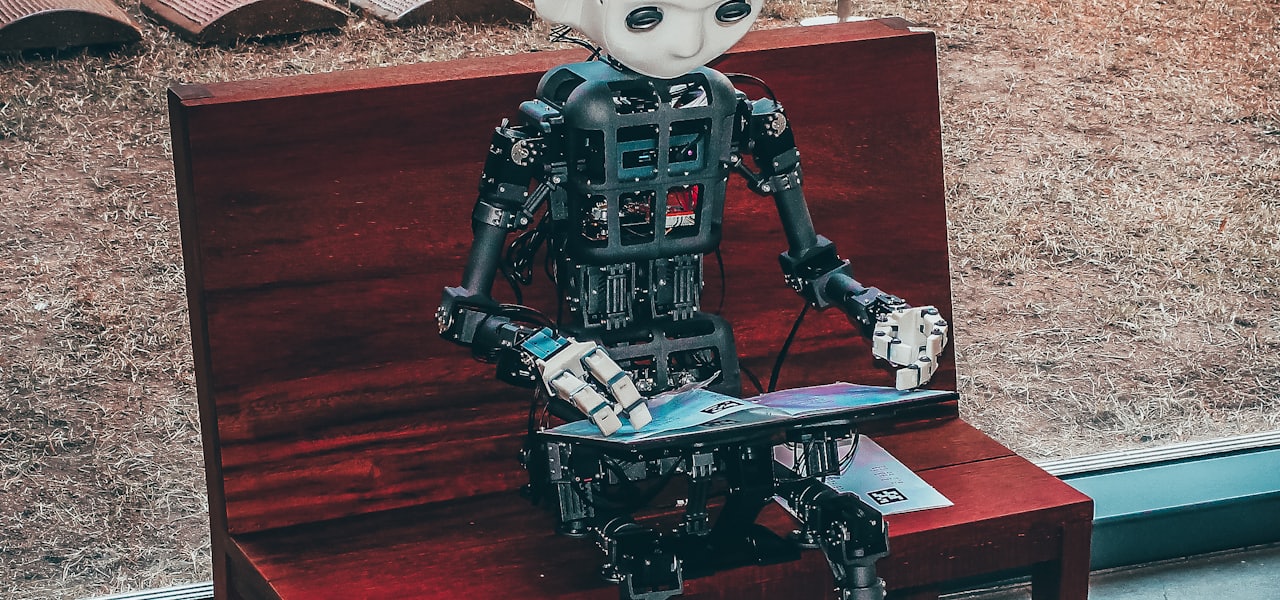
Winner-take-all is a computer science concept that has been widely applied in behavior-based robotics as a method of action selection for intelligent agents. Winner-take-all systems work by connecting modules (task-designated areas) in such a way that when one action is performed it stops all other actions from being performed, so only one action is occurring at a time. The name comes from the idea that the "winner" action takes all of the motor system's power. == History == In the 1980s and 1990s, many roboticists and cognitive scientists were attempting to find speedier and more efficient alternatives to the traditional world modeling method of action selection. In 1982, Jerome A. Feldman and D.H. Ballard published the "Connectionist Models and Their Properties", referencing and explaining winner-take-all as a method of action selection. Feldman's architecture functioned on the simple rule that in a network of interconnected action modules, each module will set its own output to zero if it reads a higher input than its own in any other module. In 1986, Rodney Brooks introduced behavior-based artificial intelligence. Winner-take-all architectures for action selection soon became a common feature of behavior-based robots, because selection occurred at the level of the action modules (bottom-up) rather than at a separate cognitive level (top-down), producing a tight coupling of stimulus and reaction. == Types of winner-take-all architectures == === Hierarchy === In the hierarchical architecture, actions or behaviors are programmed in a high-to-low priority list, with inhibitory connections between all the action modules. The agent performs low-priority behaviors until a higher-priority behavior is stimulated, at which point the higher behavior inhibits all other behaviors and takes over the motor system completely. Prioritized behaviors are usually key to the immediate survival of the agent, while behaviors of lower priority are less time-sensitive. For example, "run away from predator" would be ranked above "sleep." While this architecture allows for clear programming of goals, many roboticists have moved away from the hierarchy because of its inflexibility. === Heterarchy and fully distributed === In the heterarchy and fully distributed architecture, each behavior has a set of pre-conditions to be met before it can be performed, and a set of post-conditions that will be true after the action has been performed. These pre- and post-conditions determine the order in which behaviors must be performed and are used to causally connect action modules. This enables each module to receive input from other modules as well as from the sensors, so modules can recruit each other. For example, if the agent's goal were to reduce thirst, the behavior "drink" would require the pre-condition of having water available, so the module would activate the module in charge of "find water". The activations organize the behaviors into a sequence, even though only one action is performed at a time. The distribution of larger behaviors across modules makes this system flexible and robust to noise. Some critics of this model hold that any existing set of division rules for the predecessor and conflictor connections between modules produce sub-par action selection. In addition, the feedback loop used in the model can in some circumstances lead to improper action selection. === Arbiter and centrally coordinated === In the arbiter and centrally coordinated architecture, the action modules are not connected to each other but to a central arbiter. When behaviors are triggered, they begin "voting" by sending signals to the arbiter, and the behavior with the highest number of votes is selected. In these systems, bias is created through the "voting weight", or how often a module is allowed to vote. Some arbiter systems take a different spin on this type of winner-take-all by using a "compromise" feature in the arbiter. Each module is able to vote for or against each smaller action in a set of actions, and the arbiter selects the action with the most votes, meaning that it benefits the most behavior modules. This can be seen as violating the general rule against creating representations of the world in behavior-based AI, established by Brooks. By performing command fusion, the system is creating a larger composite pool of knowledge than is obtained from the sensors alone, forming a composite inner representation of the environment. Defenders of these systems argue that forbidding world-modeling puts unnecessary constraints on behavior-based robotics, and that agents benefits from forming representations and can still remain reactive.
Trello
Trello is a web-based, kanban-style list-making application developed by Atlassian. Created in 2011 by Fog Creek Software, it was spun out to form the basis of a separate company in New York City in 2014 and sold to Atlassian in January 2017. == History == The name Trello is derived from the word trellis, which had been a code name for the project at its early stages. Trello was released at a TechCrunch event by Fog Creek founder Joel Spolsky. In September 2011 Wired magazine named the application one of "The 7 Coolest Startups You Haven't Heard of Yet". Lifehacker said "it makes project collaboration simple and kind of enjoyable". In 2014, it raised US$10.3 million in funding from Index Ventures and Spark Capital. Prior to its acquisition, Trello had sold 22% of its shares to investors, with the remaining shares held by founders Michael Pryor and Joel Spolsky. In May 2016, Trello claimed it had more than 1.1 million daily active users and 14 million total signups. In May 2015, Trello expanded internationally with localized interfaces for Brazil, Germany, and Spain. In 2016 Trello launched the Power-Up platform, allowing 3rd party developers to build and distribute extensions known as Power-Ups to Trello. Initial integrations included Zendesk, SurveyMonkey and Giphy. By January 2022 there were a total of 247 power-ups listed in the Power-Up directory. On 9 January 2017, Atlassian announced its intent to acquire Trello for $425 million. The transaction was made with $360 million in cash and $65 million in shares and options. In December 2018, Trello announced its acquisition of Butler, a company that developed a leading power-up for automating tasks within a Trello board. Trello announced 35 million users in March 2019 and 50 million users in October 2019. In 2020 Craig Jones, then cybersecurity operations director at Sophos, found that the company exposed the personally identifiable information (PII) data of its users, exposed through public Trello boards; the researcher first tweeted about this issue in the year 2018. On 16 January 2024 Trello suffered a data breach containing over 15 million unique email addresses, names and usernames, when the data was posted on a popular hacking forum. The data was obtained by enumerating a publicly accessible resource using email addresses from previous breach corpuses; it was then added on 22 January 2024 to the famous website collecting data breaches "Have I Been Pwned?". == Uses == Users can create task boards with different columns and move the tasks between them. Typically columns include task statuses such as To Do, In Progress, Done. The tool can be used for personal and business purposes including real estate management, software project management, school bulletin boards, lesson planning, accounting, web design, gaming, and law office case management. == Architecture == According to a Fog Creek blog post in January 2012, the client was a thin web layer which downloads the main app, written in CoffeeScript and compiled to minified JavaScript, using Backbone.js, HTML5 .pushState(), and the Mustache templating language. The server was built on top of MongoDB, Node.js and a modified version of Socket.io. == Reception == On 26 January 2017, PC Magazine gave Trello a 3.5 / 5 rating, calling it "flexible" and saying that "you can get rather creative", while noting that "it may require some experimentation to figure out how to best use it for your team and the workload you manage."
Probabilistic automaton
In mathematics and computer science, the probabilistic automaton (PA) is a generalization of the nondeterministic finite automaton; it includes the probability of a given transition into the transition function, turning it into a transition matrix. Thus, the probabilistic automaton also generalizes the concepts of a Markov chain and of a subshift of finite type. The languages recognized by probabilistic automata are called stochastic languages; these include the regular languages as a subset. The number of stochastic languages is uncountable. The concept was introduced by Michael O. Rabin in 1963; a certain special case is sometimes known as the Rabin automaton (not to be confused with the subclass of ω-automata also referred to as Rabin automata). In recent years, a variant has been formulated in terms of quantum probabilities, the quantum finite automaton. == Informal Description == For a given initial state and input character, a deterministic finite automaton (DFA) has exactly one next state, and a nondeterministic finite automaton (NFA) has a set of next states. A probabilistic automaton (PA) instead has a weighted set (or vector) of next states, where the weights must sum to 1 and therefore can be interpreted as probabilities (making it a stochastic vector). The notions states and acceptance must also be modified to reflect the introduction of these weights. The state of the machine as a given step must now also be represented by a stochastic vector of states, and a state accepted if its total probability of being in an acceptance state exceeds some cut-off. A PA is in some sense a half-way step from deterministic to non-deterministic, as it allows a set of next states but with restrictions on their weights. However, this is somewhat misleading, as the PA utilizes the notion of the real numbers to define the weights, which is absent in the definition of both DFAs and NFAs. This additional freedom enables them to decide languages that are not regular, such as the p-adic languages with irrational parameters. As such, PAs are more powerful than both DFAs and NFAs (which are famously equally powerful). == Formal Definition == The probabilistic automaton may be defined as an extension of a nondeterministic finite automaton ( Q , Σ , δ , q 0 , F ) {\displaystyle (Q,\Sigma ,\delta ,q_{0},F)} , together with two probabilities: the probability P {\displaystyle P} of a particular state transition taking place, and with the initial state q 0 {\displaystyle q_{0}} replaced by a stochastic vector giving the probability of the automaton being in a given initial state. For the ordinary non-deterministic finite automaton, one has a finite set of states Q {\displaystyle Q} a finite set of input symbols Σ {\displaystyle \Sigma } a transition function δ : Q × Σ → ℘ ( Q ) {\displaystyle \delta :Q\times \Sigma \to \wp (Q)} a set of states F {\displaystyle F} distinguished as accepting (or final) states F ⊆ Q {\displaystyle F\subseteq Q} . Here, ℘ ( Q ) {\displaystyle \wp (Q)} denotes the power set of Q {\displaystyle Q} . By use of currying, the transition function δ : Q × Σ → ℘ ( Q ) {\displaystyle \delta :Q\times \Sigma \to \wp (Q)} of a non-deterministic finite automaton can be written as a membership function δ : Q × Σ × Q → { 0 , 1 } {\displaystyle \delta :Q\times \Sigma \times Q\to \{0,1\}} so that δ ( q , a , q ′ ) = 1 {\displaystyle \delta (q,a,q^{\prime })=1} if q ′ ∈ δ ( q , a ) {\displaystyle q^{\prime }\in \delta (q,a)} and 0 {\displaystyle 0} otherwise. The curried transition function can be understood to be a matrix with matrix entries [ θ a ] q q ′ = δ ( q , a , q ′ ) {\displaystyle \left[\theta _{a}\right]_{qq^{\prime }}=\delta (q,a,q^{\prime })} The matrix θ a {\displaystyle \theta _{a}} is then a square matrix, whose entries are zero or one, indicating whether a transition q → a q ′ {\displaystyle q{\stackrel {a}{\rightarrow }}q^{\prime }} is allowed by the NFA. Such a transition matrix is always defined for a non-deterministic finite automaton. The probabilistic automaton replaces these matrices by a family of right stochastic matrices P a {\displaystyle P_{a}} , for each symbol a in the alphabet Σ {\displaystyle \Sigma } so that the probability of a transition is given by [ P a ] q q ′ {\displaystyle \left[P_{a}\right]_{qq^{\prime }}} A state change from some state to any state must occur with probability one, of course, and so one must have ∑ q ′ [ P a ] q q ′ = 1 {\displaystyle \sum _{q^{\prime }}\left[P_{a}\right]_{qq^{\prime }}=1} for all input letters a {\displaystyle a} and internal states q {\displaystyle q} . The initial state of a probabilistic automaton is given by a row vector v {\displaystyle v} , whose components are the probabilities of the individual initial states q {\displaystyle q} , that add to 1: ∑ q [ v ] q = 1 {\displaystyle \sum _{q}\left[v\right]_{q}=1} The transition matrix acts on the right, so that the state of the probabilistic automaton, after consuming the input string a b c {\displaystyle abc} , would be v P a P b P c {\displaystyle vP_{a}P_{b}P_{c}} In particular, the state of a probabilistic automaton is always a stochastic vector, since the product of any two stochastic matrices is a stochastic matrix, and the product of a stochastic vector and a stochastic matrix is again a stochastic vector. This vector is sometimes called the distribution of states, emphasizing that it is a discrete probability distribution. Formally, the definition of a probabilistic automaton does not require the mechanics of the non-deterministic automaton, which may be dispensed with. Formally, a probabilistic automaton PA is defined as the tuple ( Q , Σ , P , v , F ) {\displaystyle (Q,\Sigma ,P,v,F)} . A Rabin automaton is one for which the initial distribution v {\displaystyle v} is a coordinate vector; that is, has zero for all but one entries, and the remaining entry being one. == Stochastic languages == The set of languages recognized by probabilistic automata are called stochastic languages. They include the regular languages as a subset. Let F = Q accept ⊆ Q {\displaystyle F=Q_{\text{accept}}\subseteq Q} be the set of "accepting" or "final" states of the automaton. By abuse of notation, Q accept {\displaystyle Q_{\text{accept}}} can also be understood to be the column vector that is the membership function for Q accept {\displaystyle Q_{\text{accept}}} ; that is, it has a 1 at the places corresponding to elements in Q accept {\displaystyle Q_{\text{accept}}} , and a zero otherwise. This vector may be contracted with the internal state probability, to form a scalar. The language recognized by a specific automaton is then defined as L η = { s ∈ Σ ∗ | v P s Q accept > η } {\displaystyle L_{\eta }=\{s\in \Sigma ^{}\vert vP_{s}Q_{\text{accept}}>\eta \}} where Σ ∗ {\displaystyle \Sigma ^{}} is the set of all strings in the alphabet Σ {\displaystyle \Sigma } (so that is the Kleene star). The language depends on the value of the cut-point η {\displaystyle \eta } , normally taken to be in the range 0 ≤ η < 1 {\displaystyle 0\leq \eta <1} . A language is called η-stochastic if and only if there exists some PA that recognizes the language, for fixed η {\displaystyle \eta } . A language is called stochastic if and only if there is some 0 ≤ η < 1 {\displaystyle 0\leq \eta <1} for which L η {\displaystyle L_{\eta }} is η-stochastic. A cut-point is said to be an isolated cut-point if and only if there exists a δ > 0 {\displaystyle \delta >0} such that | v P ( s ) Q accept − η | ≥ δ {\displaystyle \vert vP(s)Q_{\text{accept}}-\eta \vert \geq \delta } for all s ∈ Σ ∗ {\displaystyle s\in \Sigma ^{}} == Properties == Every regular language is stochastic, and more strongly, every regular language is η-stochastic. A weak converse is that every 0-stochastic language is regular; however, the general converse does not hold: there are stochastic languages that are not regular. Every η-stochastic language is stochastic, for some 0 < η < 1 {\displaystyle 0<\eta <1} . Every stochastic language is representable by a Rabin automaton. If η {\displaystyle \eta } is an isolated cut-point, then L η {\displaystyle L_{\eta }} is a regular language. == p-adic languages == The p-adic languages provide an example of a stochastic language that is not regular, and also show that the number of stochastic languages is uncountable. A p-adic language is defined as the set of strings L η ( p ) = { n 1 n 2 n 3 … | 0 ≤ n k < p and 0. n 1 n 2 n 3 … > η } {\displaystyle L_{\eta }(p)=\{n_{1}n_{2}n_{3}\ldots \vert 0\leq n_{k}
Tom M. Mitchell
Tom Michael Mitchell (born August 9, 1951) is an American computer scientist and the Founders University Professor at Carnegie Mellon University (CMU). He is a founder and former chair of the Machine Learning Department at CMU. Mitchell is known for his contributions to the advancement of machine learning, artificial intelligence, and cognitive neuroscience and is the author of the textbook Machine Learning. He is a member of the United States National Academy of Engineering since 2010. He is also a Fellow of the American Academy of Arts and Sciences, the American Association for the Advancement of Science and a Fellow and past president of the Association for the Advancement of Artificial Intelligence. In October 2018, Mitchell was appointed as the Interim Dean of the School of Computer Science at Carnegie Mellon. == Early life and education == Mitchell was born in Blossburg, Pennsylvania and grew up in Upstate New York, in the town of Vestal. He received his bachelor of Science degree in electrical engineering from the Massachusetts Institute of Technology in 1973 and a Ph.D. from Stanford University under the direction of Bruce G. Buchanan in 1979. == Career == Mitchell began his teaching career at Rutgers University in 1978. During his tenure at Rutgers, he held the positions of assistant and associate professor in the Department of Computer Science. In 1986, he left Rutgers and joined Carnegie Mellon University, Pittsburgh as a professor. In 1999, he became the E. Fredkin Professor in the School of Computer Science. In 2006 Mitchell was appointed as the first chair of the Machine Learning Department within the School of Computer Science. He became university professor in 2009, and served as Interim Dean of the Carnegie Mellon School of Computer Science during 2018–2019. Mitchell currently serves on the Scientific Advisory Board of the Allen Institute for AI and on the Science Board of the Santa Fe Institute. == Honors and awards == He was elected into the United States National Academy of Engineering in 2010 "for pioneering contributions and leadership in the methods and applications of machine learning." He is also a Fellow of the American Association for the Advancement of Science (AAAS) since 2008 and a Fellow the Association for the Advancement of Artificial Intelligence (AAAI) since 1990. In 2016 he became a Fellow of the American Academy of Arts and Sciences. Mitchell was awarded an Honorary Doctor of Laws degree from Dalhousie University in 2015 for his contributions to machine learning and to cognitive neuroscience, and the President's Medal from Stevens Institute of Technology in 2018. He is a recipient of the NSF Presidential Young Investigator Award in 1984. == Publications == Mitchell is a prolific author of scientific works on various topics in computer science, including machine learning, artificial intelligence, robotics, and cognitive neuroscience. He has authored hundreds of scientific articles. Mitchell published one of the first textbooks in machine learning, entitled Machine Learning, in 1997 (publisher: McGraw Hill Education). He is also a coauthor of the following books: J. Franklin, T. Mitchell, and S. Thrun (eds.), Recent Advances in Robot Learning, Kluwer Academic Publishers, 1996. T. Mitchell, J. Carbonell, and R. Michalski (eds.), Machine Learning: A Guide to Current Research, Kluwer Academic Publishers, 1986. R. Michalski, J. Carbonell, and T. Mitchell (eds.), Machine Learning: An Artificial Intelligence Approach, Volume 2, Morgan Kaufmann, 1986. R. Michalski, J. Carbonell, and T. Mitchell (eds.), Machine Learning: An Artificial Intelligence Approach, Tioga Press, 1983.
Timnit Gebru
Timnit W. Gebru (Amharic and Tigrinya: ትምኒት ገብሩ; 1982/1983) is an Eritrean Ethiopian-born computer scientist who works in the fields of artificial intelligence (AI), algorithmic bias and data mining. She is a co-founder of Black in AI, an advocacy group that has pushed for more Black roles in AI development and research. She is the founder of the Distributed Artificial Intelligence Research Institute (DAIR). In December 2020, public controversy erupted over the circumstances surrounding Gebru's departure from Google, where she was technical co-lead of the Ethical Artificial Intelligence Team. Gebru had coauthored a paper on the risks of large language models (LLMs) acting as stochastic parrots, and submitted it for publication. According to Jeff Dean, head of Google AI, the paper was submitted without waiting for Google's internal review, which then asserted that it ignored too much relevant research. Google management requested that Gebru either withdraw the paper or remove the names of all the authors employed by Google. Gebru requested the identity and feedback of every reviewer, and stated that if Google refused, she would talk to her manager about "a last date". Google terminated her employment immediately, stating that they were accepting her resignation. Gebru maintained that she had not formally offered to resign, and only threatened to. Gebru has been widely recognized for her expertise in the ethics of artificial intelligence. She was named one of the World's 50 Greatest Leaders by Fortune and one of Nature's ten people who shaped science in 2021, and in 2022, one of Time's most influential people. == Early life and education == Gebru was raised in Addis Ababa, Ethiopia. Her father, an electrical engineer with a Doctor of Philosophy (PhD), died when she was five years old, and she was raised by her mother, an economist. Both her parents are from Eritrea. When Gebru was 15, during the Eritrean–Ethiopian War, she fled Ethiopia after some of her family were deported to Eritrea and compelled to fight in the war. She was initially denied a U.S. visa and briefly lived in Ireland, but she eventually received political asylum in the U.S., an experience she said was "miserable". Gebru settled in Somerville, Massachusetts to attend high school, where she says she immediately started to experience racial discrimination, with some teachers refusing to allow her to take certain Advanced Placement courses, despite being a high-achiever. After she completed high school, an encounter with the police set Gebru on a course toward a focus on ethics in technology. A friend of hers, a Black woman, was assaulted in a bar, and Gebru called the police to report it. She says that instead of filing the assault report, her friend was arrested and remanded to a cell. Gebru called it a pivotal moment and a "blatant example of systemic racism." In 2001, Gebru was accepted at Stanford University. There, she earned her Bachelor of Science and Master of Science degrees in electrical engineering and her PhD in computer vision in 2017. Gebru was advised during her PhD program by Fei-Fei Li. During the 2008 United States presidential election, Gebru canvassed in support of Barack Obama. Gebru presented her doctoral research at the 2017 LDV Capital Vision Summit competition, where computer vision scientists present their work to members of industry and venture capitalists. Gebru won the competition, starting a series of collaborations with other entrepreneurs and investors. Both during her PhD program in 2016 and in 2018, Gebru returned to Ethiopia with Jelani Nelson's programming campaign, AddisCoder. While working on her PhD, Gebru authored a paper that was never published about her concern over the future of AI. She wrote of the dangers of the lack of diversity in the field, centered on her experiences with the police and on a ProPublica investigation into predictive policing, which revealed a projection of human biases in machine learning. In the paper, she scathed the "boy's club culture", reflecting on her experiences at conference gatherings of drunken male attendees sexually harassing her, and criticized the hero worship of the field's celebrities. == Career == === 2004–2013: Software development at Apple === Gebru joined Apple as an intern while at Stanford, working in their hardware division making circuitry for audio components, and was offered a full-time position the following year. Of her work as an audio engineer, her manager told Wired she was "fearless", and well-liked by her colleagues. During her tenure at Apple, Gebru became more interested in building software, namely computer vision that could detect human figures. She went on to develop signal processing algorithms for the first iPad. At the time, she said she did not consider the potential use for surveillance, saying "I just found it technically interesting." Long after leaving the company, during the #AppleToo movement in the summer of 2021, which was led by Apple engineer Cher Scarlett, who consulted with Gebru, Gebru revealed she experienced "so many egregious things" and "always wondered how they manage[d] to get out of the spotlight." She said that accountability at Apple was long overdue, and warned they could not continue to fly under the radar for much longer. Gebru also criticized the way the media covers Apple and other tech giants, saying that the press helps shield such companies from public scrutiny. === 2013–2017: Research at Stanford and Microsoft === In 2013, Gebru joined Fei-Fei Li's lab at Stanford, where she combined deep learning with Google Street View to estimate the demographics of United States neighbourhoods, showing that socioeconomic attributes such as voting patterns, income, race, and education can be inferred from observations of cars. In 2015, Gebru attended the field's top conference, Neural Information Processing Systems (NIPS), in Montreal, Canada. Out of 3,700 attendees, she noted she was one of only a few Black researchers. When she attended again the following year, she kept a tally and noted that there were only five Black men and that she was the only Black woman out of 8,500 delegates. Together with her colleague Rediet Abebe, Gebru founded Black in AI, a community of Black researchers working in artificial intelligence that aims to increase the presence, visibility, and well-being of Black professionals and leaders within the field. In the summer of 2017, Gebru joined Microsoft as a postdoctoral researcher in the Fairness, Accountability, Transparency, and Ethics in AI (FATE) lab. In 2017, Gebru spoke at the Fairness and Transparency conference, where MIT Technology Review interviewed her about biases that exist in AI systems and how adding diversity in AI teams can fix that issue. In her interview with Jackie Snow, Snow asked Gebru, "How does the lack of diversity distort artificial intelligence and specifically computer vision?" and Gebru pointed out that there are biases that exist in the software developers. While at Microsoft, Gebru co-authored a research paper called Gender Shades, which became the namesake of a project of a broader Massachusetts Institute of Technology project led by co-author Joy Buolamwini. The pair investigated facial recognition software, finding that in one particular implementation Black women were 35% less likely to be recognized than White men. === 2018–2020: Artificial intelligence ethics at Google === Gebru joined Google in 2018, where she co-led a team on the ethics of artificial intelligence with Margaret Mitchell. She studied the implications of artificial intelligence, looking to improve the ability of technology to do social good. In 2019, Gebru and other artificial intelligence researchers "signed a letter calling on Amazon to stop selling its facial-recognition technology to law enforcement agencies because it is biased against women and people of color", citing a study that was conducted by MIT researchers showing that Amazon's facial recognition system had more trouble identifying darker-skinned females than any other technology company's facial recognition software. In a New York Times interview, Gebru has further expressed that she believes facial recognition is too dangerous to be used for law enforcement and security purposes at present. === Exit from Google === In 2020 Gebru and five co-authors wrote a paper titled "On the Dangers of Stochastic Parrots: Can Language Models Be Too Big? 🦜". The paper examined risks of very large language models, including their environmental footprint, financial costs, the inscrutability of large models, the potential for LLMs to display prejudice against certain groups, the inability of LLMs to understand the language they process, and the use of LLMs to spread disinformation. In December 2020, her employment with Google ended after Google management asked her to either withdraw the paper before publication, or remove the names of all the Google employees from
Reasoning model
A reasoning model, also known as a reasoning language model (RLM) or large reasoning model (LRM), is a type of large language model (LLM) that has been specifically trained to solve complex tasks requiring multiple steps of logical reasoning. These models demonstrate superior performance on logic, mathematics, and programming tasks compared to standard LLMs. They possess the ability to revisit and revise earlier reasoning steps and utilize additional computation during inference as a method to scale performance, complementing traditional scaling approaches based on training data size, model parameters, and training compute. == Overview == Unlike traditional language models that generate responses immediately, reasoning models allocate additional compute, or thinking, time before producing an answer to solve multi-step problems. OpenAI introduced this terminology in September 2024 when it released the o1 series, describing the models as designed to "spend more time thinking" before responding. The company framed o1 as a reset in model naming that targets complex tasks in science, coding, and mathematics, and it contrasted o1's performance with GPT-4o on benchmarks such as AIME and Codeforces. Independent reporting the same week summarized the launch and highlighted OpenAI's claim that o1 automates chain-of-thought style reasoning to achieve large gains on difficult exams. In operation, reasoning models generate internal chains of intermediate steps, then select and refine a final answer. OpenAI reported that o1's accuracy improves as the model is given more reinforcement learning during training and more test-time compute at inference. The company initially chose to hide raw chains and instead return a model-written summary, stating that it "decided not to show" the underlying thoughts so researchers could monitor them without exposing unaligned content to end users. Commercial deployments document separate "reasoning tokens" that meter hidden thinking and a control for "reasoning effort" that tunes how much compute the model uses. These features make the models slower than ordinary chat systems while enabling stronger performance on difficult problems. == History == The research trajectory toward reasoning models combined advances in supervision, prompting, and search-style inference. Early alignment work on reinforcement learning from human feedback showed that models can be fine-tuned to follow instructions with "human feedback" and preference-based rewards. In 2022, Google Research scientists Jason Wei and Denny Zhou showed that chain-of-thought prompting "significantly improves the ability" of large models on complex reasoning tasks. Input → Step 1 → Step 2 → ⋯ → Step n ⏟ Reasoning chain → Answer {\displaystyle {\text{Input}}\rightarrow \underbrace {{\text{Step}}_{1}\rightarrow {\text{Step}}_{2}\rightarrow \cdots \rightarrow {\text{Step}}_{n}} _{\text{Reasoning chain}}\rightarrow {\text{Answer}}} A companion result demonstrated that the simple instruction "Let's think step by step" can elicit zero-shot reasoning. Follow-up work introduced self-consistency decoding, which "boosts the performance" of chain-of-thought by sampling diverse solution paths and choosing the consensus, and tool-augmented methods such as ReAct, a portmanteau of Reason and Act, that prompt models to "generate both reasoning traces" and actions. Research then generalized chain-of-thought into search over multiple candidate plans. The Tree-of-Thoughts framework from Princeton computer scientist Shunyu Yao proposes that models "perform deliberate decision making" by exploring and backtracking over a tree of intermediate thoughts. OpenAI's reported breakthrough focused on supervising reasoning processes rather than only outcomes, with Lightman et al.'s "Let's Verify Step by Step" reporting that rewarding each correct step "significantly outperforms outcome supervision" on challenging math problems and improves interpretability by aligning the chain-of-thought with human judgment. OpenAI's o1 announcement ties these strands together with a large-scale reinforcement learning algorithm that trains the model to refine its own chain of thought, and it reports that accuracy rises with more training compute and more time spent thinking at inference. Together, these developments define the core of reasoning models. They use supervision signals that evaluate the quality of intermediate steps, they exploit inference-time exploration such as consensus or tree search, and they expose controls for how much internal thinking compute to allocate. OpenAI's o1 family made this approach available at scale in September 2024 and popularized the label "reasoning model" for LLMs that deliberately think before they answer. The development of reasoning models illustrates Richard S. Sutton's "bitter lesson" that scaling compute typically outperforms methods based on human-designed insights. This principle was demonstrated by researchers at the Generative AI Research Lab (GAIR), who initially attempted to replicate o1's capabilities using sophisticated methods including tree search and reinforcement learning in late 2024. Their findings, published in the "o1 Replication Journey" series, revealed that knowledge distillation, a comparatively straightforward technique that trains a smaller model to mimic o1's outputs, produced unexpectedly strong performance. This outcome illustrated how direct scaling approaches can, at times, outperform more complex engineering solutions. === Drawbacks === Reasoning models require significantly more computational resources during inference compared to non-reasoning models. Research on the American Invitational Mathematics Examination (AIME) benchmark found that reasoning models were 10 to 74 times more expensive to operate than their non-reasoning counterparts. The extended inference time is attributed to the detailed, step-by-step reasoning outputs that these models generate, which are typically much longer than responses from standard large language models that provide direct answers without showing their reasoning process. One researcher in early 2025 argued that these models may face potential additional denial-of-service concerns with "overthinking attacks." === Releases === ==== 2024 ==== In September 2024, OpenAI released o1-preview, a large language model with enhanced reasoning capabilities. The full version, o1, was released in December 2024. OpenAI initially shared preliminary results on its successor model, o3, in December 2024, with the full o3 model becoming available in 2025. Alibaba released reasoning versions of its Qwen large language models in November 2024. In December 2024, the company introduced QvQ-72B-Preview, an experimental visual reasoning model. In December 2024, Google introduced Deep Research in Gemini, a feature designed to conduct multi-step research tasks. On December 16, 2024, researchers demonstrated that by scaling test-time compute, a relatively small Llama 3B model could outperform a much larger Llama 70B model on challenging reasoning tasks. This experiment suggested that improved inference strategies can unlock reasoning capabilities even in smaller models. ==== 2025 ==== In January 2025, DeepSeek released R1, a reasoning model that achieved performance comparable to OpenAI's o1 at significantly lower computational cost. The release demonstrated the effectiveness of Group Relative Policy Optimization (GRPO), a reinforcement learning technique used to train the model. On January 25, 2025, DeepSeek enhanced R1 with web search capabilities, allowing the model to retrieve information from the internet while performing reasoning tasks. Research during this period further validated the effectiveness of knowledge distillation for creating reasoning models. The s1-32B model achieved strong performance through budget forcing and scaling methods, reinforcing findings that simpler training approaches can be highly effective for reasoning capabilities. On February 2, 2025, OpenAI released Deep Research, a feature powered by their o3 model that enables users to conduct comprehensive research tasks. The system generates detailed reports by automatically gathering and synthesizing information from multiple web sources. OpenAI called GPT-4.5 its "last non-chain-of-thought model", and implemented with GPT-5 a router model that selects a model based on the difficulty of the task. ==== 2026 ==== In January 2026, Moonshot AI released Kimi K2.5, an open-source 1 trillion parameter MoE model with 32 billion active parameters. It uses an “Agent Swarm” system that dynamically decomposes tasks into sub-agents for reasoning and execution, enabling more scalable multi-step problem solving than a single sequential reasoning chain. == Training == Reasoning models follow the familiar large-scale pretraining used for frontier language models, then diverge in the post-training and optimization. OpenAI reports that o1 is trained with a large-
Is an AI Bug Finder Worth It in 2026?
In search of the best AI bug finder? An AI bug finder is software that uses machine learning to help you get more done — it turns a rough idea into a polished result in seconds. When choosing one, weigh output quality, pricing, export formats, and how well it fits the tools you already use. Whether you are a beginner or a pro, the right AI bug finder slots into your workflow and pays for itself fast. Below we compare features, pricing, and real output so you can choose with confidence.