TSheets was a web-based and mobile time tracking and employee scheduling app. The service was accessed via a web browser or a mobile app. TSheets was an alternative to a paper timesheet or punch cards. == History == Based in Eagle, Idaho, TSheets was co-founded in 2006 by CEO Matt Rissell and CTO Brandon Zehm. In 2008, TSheets released a native employee time tracking app for the iPhone. In 2012, TSheets released an integration with accounting and payroll software QuickBooks. In 2015, TSheets accepted $15 million in growth equity funding from Summit Partners, bought a building in Eagle, Idaho, and opened a second location in Sydney, Australia. On 5 December 2017, Intuit announced an agreement to acquire TSheets. The transaction was valued at approximately $340 million of cash and other consideration and closed on 11 January 2018. After the transaction closed, Time Capture became a new business unit within Intuit's Small Business and Self-Employed Group with Matt Rissell assuming the leader role reporting to Alex Chriss. TSheets's Eagle, Idaho site became an Intuit location.
Graphics address remapping table
The graphics address remapping table (GART), also known as the graphics aperture remapping table, or graphics translation table (GTT), is an I/O memory management unit (IOMMU) used by Accelerated Graphics Port (AGP) and PCI Express (PCIe) graphics cards. The GART allows the graphics card direct memory access (DMA) to the host system memory, through which buffers of textures, polygon meshes and other data are loaded. AMD later reused the same mechanism for I/O virtualization with other peripherals including disk controllers and network adapters. A GART is used as a means of data exchange between the main memory and video memory through which buffers (i.e. paging/swapping) of textures, polygon meshes and other data are loaded, but can also be used to expand the amount of video memory available for systems with only integrated or shared graphics (i.e. no discrete or inbuilt graphics processor), such as Intel HD Graphics processors. However, this type of memory (expansion) remapping has a caveat that affects the entire system: specifically, any GART, pre-allocated memory becomes pooled and cannot be utilised for any other purposes but graphics memory and display rendering. Since PCI Express, the GART is extended to the GTT (Graphics Translation Table), which act as a buffer or cache between system memory and graphics card, and in PCI Express, the GTT buffer size is changeable by the GPU driver. == Operating system support == === Windows === Support for AGP GART was added since Windows 95 OSR2. Later, support for GTT was added since Windows XP SP2 and Windows Vista. === Linux === Jeff Hartmann served as the primary maintainer of the Linux kernel's agpgart driver, which began as part of Brian Paul's Utah GLX accelerated Mesa 3D driver project. The developers primarily targeted Linux 2.4.x kernels, but made patches available against older 2.2.x kernels. Dave Jones heavily reworked agpgart for the Linux 2.6.x kernels, along with more contributions from Jeff Hartmann. === FreeBSD === In FreeBSD, the agpgart driver appeared in its 4.1 release. === Solaris === AGPgart support was introduced into Solaris Express Developer Edition as of its 7/05 release.
Multisample anti-aliasing
Multisample anti-aliasing (MSAA) is a type of spatial anti-aliasing, a technique used in computer graphics to remove jaggies. It is an optimization of supersampling, where only the necessary parts are sampled more. Jaggies are only noticed in a small area, so the area is quickly found, and only that is anti-aliased. == Definition == The term generally refers to a special case of supersampling. Initial implementations of full-scene anti-aliasing (FSAA) worked conceptually by simply rendering a scene at a higher resolution, and then downsampling to a lower-resolution output. Most modern GPUs are capable of this form of anti-aliasing, but it greatly taxes resources such as texture, bandwidth, and fillrate. (If a program is highly TCL-bound or CPU-bound, supersampling can be used without much performance hit.) According to the OpenGL GL_ARB_multisample specification, "multisampling" refers to a specific optimization of supersampling. The specification dictates that the renderer evaluate the fragment program once per pixel, and only "truly" supersample the depth and stencil values. (This is not the same as supersampling but, by the OpenGL 1.5 specification, the definition had been updated to include fully supersampling implementations as well.) In graphics literature in general, "multisampling" refers to any special case of supersampling where some components of the final image are not fully supersampled. The lists below refer specifically to the ARB_multisample definition. == Description == In supersample anti-aliasing, multiple locations are sampled within every pixel, and each of those samples is fully rendered and combined with the others to produce the pixel that is ultimately displayed. This is computationally expensive, because the entire rendering process must be repeated for each sample location. It is also inefficient, as aliasing is typically only noticed in some parts of the image, such as the edges, whereas supersampling is performed for every single pixel. In multisample anti-aliasing, if any of the multi sample locations in a pixel is covered by the triangle being rendered, a shading computation must be performed for that triangle. However this calculation only needs to be performed once for the whole pixel regardless of how many sample positions are covered; the result of the shading calculation is simply applied to all of the relevant multi sample locations. In the case where only one triangle covers every multi sample location within the pixel, only one shading computation is performed, and these pixels are little more expensive than (and the result is no different from) the non-anti-aliased image. This is true of the middle of triangles, where aliasing is not an issue. (Edge detection can reduce this further by explicitly limiting the MSAA calculation to pixels whose samples involve multiple triangles, or triangles at multiple depths.) In the extreme case where each of the multi sample locations is covered by a different triangle, a different shading computation will be performed for each location and the results then combined to give the final pixel, and the result and computational expense are the same as in the equivalent supersampled image. The shading calculation is not the only operation that must be performed on a given pixel; multisampling implementations may variously sample other operations such as visibility at different sampling levels. == Advantages == The pixel shader usually only needs to be evaluated once per pixel for every triangle covering at least one sample point. The edges of polygons (the most obvious source of aliasing in 3D graphics) are anti-aliased. Since multiple subpixels per pixel are sampled, polygonal details smaller than one pixel that might have been missed without MSAA can be captured and made a part of the final rendered image if enough samples are taken. == Disadvantages == === Alpha testing === Alpha testing is a technique common to older video games used to render translucent objects by rejecting pixels from being written to the framebuffer. If the alpha value of a translucent fragment (pixel) is below a specified threshold, it will be discarded. Because this is performed on a pixel by pixel basis, the image does not receive the benefits of multi-sampling (all of the multisamples in a pixel are discarded based on the alpha test) for these pixels. The resulting image may contain aliasing along the edges of transparent objects or edges within textures, although the image quality will be no worse than it would be without any anti-aliasing. Translucent objects that are modelled using alpha-test textures will also be aliased due to alpha testing. This effect can be minimized by rendering objects with transparent textures multiple times, although this would result in a high performance reduction for scenes containing many transparent objects. === Aliasing === Because multi-sampling calculates interior polygon fragments only once per pixel, aliasing and other artifacts will still be visible inside rendered polygons where fragment shader output contains high frequency components. === Performance === While less performance-intensive than SSAA (supersampling), it is possible in certain scenarios (scenes heavy in complex fragments) for MSAA to be multiple times more intensive for a given frame than post processing anti-aliasing techniques such as FXAA, SMAA and MLAA. Early techniques in this category tend towards a lower performance impact, but suffer from accuracy problems. More recent post-processing based anti-aliasing techniques such as temporal anti-aliasing (TAA), which reduces aliasing by combining data from previously rendered frames, have seen the reversal of this trend, as post-processing AA becomes both more versatile and more expensive than MSAA, which cannot antialias an entire frame alone. == Sampling methods == === Point sampling === In a point-sampled mask, the coverage bit for each multisample is only set if the multisample is located inside the rendered primitive. Samples are never taken from outside a rendered primitive, so images produced using point-sampling will be geometrically correct, but filtering quality may be low because the proportion of bits set in the pixel's coverage mask may not be equal to the proportion of the pixel that is actually covered by the fragment in question. === Area sampling === Filtering quality can be improved by using area sampled masks. In this method, the number of bits set in a coverage mask for a pixel should be proportionate to the actual area coverage of the fragment. This will result in some coverage bits being set for multisamples that are not actually located within the rendered primitive, and can cause aliasing and other artifacts. == Sample patterns == === Regular grid === A regular grid sample pattern, where multisample locations form an evenly spaced grid throughout the pixel, is easy to implement and simplifies attribute evaluation (i.e. setting subpixel masks, sampling color and depth). This method is computationally expensive due to the large number of samples. Edge optimization is poor for screen-aligned edges, but image quality is good when the number of multisamples is large. === Sparse regular grid === A sparse regular grid sample pattern is a subset of samples that are chosen from the regular grid sample pattern. As with the regular grid, attribute evaluation is simplified due to regular spacing. The method is less computationally expensive due to having a fewer samples. Edge optimization is good for screen aligned edges, and image quality is good for a moderate number of multisamples. === Stochastic sample patterns === A stochastic sample pattern is a random distribution of multisamples throughout the pixel. The irregular spacing of samples makes attribute evaluation complicated. The method is cost efficient due to low sample count (compared to regular grid patterns). Edge optimization with this method, although sub-optimal for screen aligned edges. Image quality is excellent for a moderate number of samples. == Quality == Compared to supersampling, multisample anti-aliasing can provide similar quality at higher performance, or better quality for the same performance. Further improved results can be achieved by using rotated grid subpixel masks. The additional bandwidth required by multi-sampling is reasonably low if Z and colour compression are available. Most modern GPUs support 2×, 4×, and 8× MSAA samples. Higher values result in better quality, but are slower.
Resolution enhancement technology
Resolution enhancement technology (RET) is a form of image processing technology used to manipulate dot characteristics popular among laser printer and inkjet printer manufacturers. Closely related RET techniques are also used in VLSI photolithography manufacturing technology, in particular in relation to 90 nanometre technology. Resolution refers to the sharpness of image detail, smoothness of curved lines, and the faithful reproduction of an image. In both cases, RET uses pre-compensation of the image in order to try to mitigate the effects of the printing process. Among the major issues in RET in VLSI technology are the fundamental properties of a wave: amplitude, phase, and direction.
Clef (app)
Clef was a San Francisco-based technology company, known for developing a mobile app that created a two-factor authentication for websites. It allowed users to access sites with a single login password management service which stores encrypted passwords in private accounts. It had a standard verification method that requires access to data on the mobile phone to confirm the user's identity. The application required a Wi-Fi or mobile network, and the user could log in by scanning the computer screen with their phone. == History == Clef was founded in 2013 by Mark Hudnall, B. Byrne and Jesse Pollak. It raised $1.6 million in seed funding in November 2014. Clef integrated with many websites and applications, including WordPress. On March 17, 2017, Clef announced they would no longer support the plugin after June 6, 2017; Clef was acquired by Authy, another 2FA service, which later got acquired by Twilio.
Matrix regularization
In the field of statistical learning theory, matrix regularization generalizes notions of vector regularization to cases where the object to be learned is a matrix. The purpose of regularization is to enforce conditions, for example sparsity or smoothness, that can produce stable predictive functions. For example, in the more common vector framework, Tikhonov regularization optimizes over min x ‖ A x − y ‖ 2 + λ ‖ x ‖ 2 {\displaystyle \min _{x}\left\|Ax-y\right\|^{2}+\lambda \left\|x\right\|^{2}} to find a vector x {\displaystyle x} that is a stable solution to the regression problem. When the system is described by a matrix rather than a vector, this problem can be written as min X ‖ A X − Y ‖ 2 + λ ‖ X ‖ 2 , {\displaystyle \min _{X}\left\|AX-Y\right\|^{2}+\lambda \left\|X\right\|^{2},} where the vector norm enforcing a regularization penalty on x {\displaystyle x} has been extended to a matrix norm on X {\displaystyle X} . Matrix regularization has applications in matrix completion, multivariate regression, and multi-task learning. Ideas of feature and group selection can also be extended to matrices, and these can be generalized to the nonparametric case of multiple kernel learning. == Basic definition == Consider a matrix W {\displaystyle W} to be learned from a set of examples, S = ( X i t , y i t ) {\displaystyle S=(X_{i}^{t},y_{i}^{t})} , where i {\displaystyle i} goes from 1 {\displaystyle 1} to n {\displaystyle n} , and t {\displaystyle t} goes from 1 {\displaystyle 1} to T {\displaystyle T} . Let each input matrix X i {\displaystyle X_{i}} be ∈ R D T {\displaystyle \in \mathbb {R} ^{DT}} , and let W {\displaystyle W} be of size D × T {\displaystyle D\times T} . A general model for the output y {\displaystyle y} can be posed as y i t = ⟨ W , X i t ⟩ F , {\displaystyle y_{i}^{t}=\left\langle W,X_{i}^{t}\right\rangle _{F},} where the inner product is the Frobenius inner product. For different applications the matrices X i {\displaystyle X_{i}} will have different forms, but for each of these the optimization problem to infer W {\displaystyle W} can be written as min W ∈ H E ( W ) + R ( W ) , {\displaystyle \min _{W\in {\mathcal {H}}}E(W)+R(W),} where E {\displaystyle E} defines the empirical error for a given W {\displaystyle W} , and R ( W ) {\displaystyle R(W)} is a matrix regularization penalty. The function R ( W ) {\displaystyle R(W)} is typically chosen to be convex and is often selected to enforce sparsity (using ℓ 1 {\displaystyle \ell ^{1}} -norms) and/or smoothness (using ℓ 2 {\displaystyle \ell ^{2}} -norms). Finally, W {\displaystyle W} is in the space of matrices H {\displaystyle {\mathcal {H}}} with Frobenius inner product ⟨ … ⟩ F {\displaystyle \langle \dots \rangle _{F}} . == General applications == === Matrix completion === In the problem of matrix completion, the matrix X i t {\displaystyle X_{i}^{t}} takes the form X i t = e t ⊗ e i ′ , {\displaystyle X_{i}^{t}=e_{t}\otimes e_{i}',} where ( e t ) t {\displaystyle (e_{t})_{t}} and ( e i ′ ) i {\displaystyle (e_{i}')_{i}} are the canonical basis in R T {\displaystyle \mathbb {R} ^{T}} and R D {\displaystyle \mathbb {R} ^{D}} . In this case the role of the Frobenius inner product is to select individual elements w i t {\displaystyle w_{i}^{t}} from the matrix W {\displaystyle W} . Thus, the output y {\displaystyle y} is a sampling of entries from the matrix W {\displaystyle W} . The problem of reconstructing W {\displaystyle W} from a small set of sampled entries is possible only under certain restrictions on the matrix, and these restrictions can be enforced by a regularization function. For example, it might be assumed that W {\displaystyle W} is low-rank, in which case the regularization penalty can take the form of a nuclear norm. R ( W ) = λ ‖ W ‖ ∗ = λ ∑ i | σ i | , {\displaystyle R(W)=\lambda \left\|W\right\|_{}=\lambda \sum _{i}\left|\sigma _{i}\right|,} where σ i {\displaystyle \sigma _{i}} , with i {\displaystyle i} from 1 {\displaystyle 1} to min D , T {\displaystyle \min D,T} , are the singular values of W {\displaystyle W} . === Multivariate regression === Models used in multivariate regression are parameterized by a matrix of coefficients. In the Frobenius inner product above, each matrix X {\displaystyle X} is X i t = e t ⊗ x i {\displaystyle X_{i}^{t}=e_{t}\otimes x_{i}} such that the output of the inner product is the dot product of one row of the input with one column of the coefficient matrix. The familiar form of such models is Y = X W + b {\displaystyle Y=XW+b} Many of the vector norms used in single variable regression can be extended to the multivariate case. One example is the squared Frobenius norm, which can be viewed as an ℓ 2 {\displaystyle \ell ^{2}} -norm acting either entrywise, or on the singular values of the matrix: R ( W ) = λ ‖ W ‖ F 2 = λ ∑ i ∑ j | w i j | 2 = λ Tr ( W ∗ W ) = λ ∑ i σ i 2 . {\displaystyle R(W)=\lambda \left\|W\right\|_{F}^{2}=\lambda \sum _{i}\sum _{j}\left|w_{ij}\right|^{2}=\lambda \operatorname {Tr} \left(W^{}W\right)=\lambda \sum _{i}\sigma _{i}^{2}.} In the multivariate case the effect of regularizing with the Frobenius norm is the same as the vector case; very complex models will have larger norms, and, thus, will be penalized more. === Multi-task learning === The setup for multi-task learning is almost the same as the setup for multivariate regression. The primary difference is that the input variables are also indexed by task (columns of Y {\displaystyle Y} ). The representation with the Frobenius inner product is then X i t = e t ⊗ x i t . {\displaystyle X_{i}^{t}=e_{t}\otimes x_{i}^{t}.} The role of matrix regularization in this setting can be the same as in multivariate regression, but matrix norms can also be used to couple learning problems across tasks. In particular, note that for the optimization problem min W ‖ X W − Y ‖ 2 2 + λ ‖ W ‖ 2 2 {\displaystyle \min _{W}\left\|XW-Y\right\|_{2}^{2}+\lambda \left\|W\right\|_{2}^{2}} the solutions corresponding to each column of Y {\displaystyle Y} are decoupled. That is, the same solution can be found by solving the joint problem, or by solving an isolated regression problem for each column. The problems can be coupled by adding an additional regularization penalty on the covariance of solutions min W , Ω ‖ X W − Y ‖ 2 2 + λ 1 ‖ W ‖ 2 2 + λ 2 Tr ( W T Ω − 1 W ) {\displaystyle \min _{W,\Omega }\left\|XW-Y\right\|_{2}^{2}+\lambda _{1}\left\|W\right\|_{2}^{2}+\lambda _{2}\operatorname {Tr} \left(W^{T}\Omega ^{-1}W\right)} where Ω {\displaystyle \Omega } models the relationship between tasks. This scheme can be used to both enforce similarity of solutions across tasks, and to learn the specific structure of task similarity by alternating between optimizations of W {\displaystyle W} and Ω {\displaystyle \Omega } . When the relationship between tasks is known to lie on a graph, the Laplacian matrix of the graph can be used to couple the learning problems. == Spectral regularization == Regularization by spectral filtering has been used to find stable solutions to problems such as those discussed above by addressing ill-posed matrix inversions (see for example Filter function for Tikhonov regularization). In many cases the regularization function acts on the input (or kernel) to ensure a bounded inverse by eliminating small singular values, but it can also be useful to have spectral norms that act on the matrix that is to be learned. There are a number of matrix norms that act on the singular values of the matrix. Frequently used examples include the Schatten p-norms, with p = 1 or 2. For example, matrix regularization with a Schatten 1-norm, also called the nuclear norm, can be used to enforce sparsity in the spectrum of a matrix. This has been used in the context of matrix completion when the matrix in question is believed to have a restricted rank. In this case the optimization problem becomes: min ‖ W ‖ ∗ subject to W i , j = Y i j . {\displaystyle \min \left\|W\right\|_{}~~{\text{ subject to }}~~W_{i,j}=Y_{ij}.} Spectral Regularization is also used to enforce a reduced rank coefficient matrix in multivariate regression. In this setting, a reduced rank coefficient matrix can be found by keeping just the top n {\displaystyle n} singular values, but this can be extended to keep any reduced set of singular values and vectors. == Structured sparsity == Sparse optimization has become the focus of much research interest as a way to find solutions that depend on a small number of variables (see e.g. the Lasso method). In principle, entry-wise sparsity can be enforced by penalizing the entry-wise ℓ 0 {\displaystyle \ell ^{0}} -norm of the matrix, but the ℓ 0 {\displaystyle \ell ^{0}} -norm is not convex. In practice this can be implemented by convex relaxation to the ℓ 1 {\displaystyle \ell ^{1}} -norm. While entry-wise regularization with an ℓ 1 {\displaystyle \ell ^{1}} -norm will find solutions with a small number of nonzero elements, applying an ℓ 1 {
Evolutionary robotics
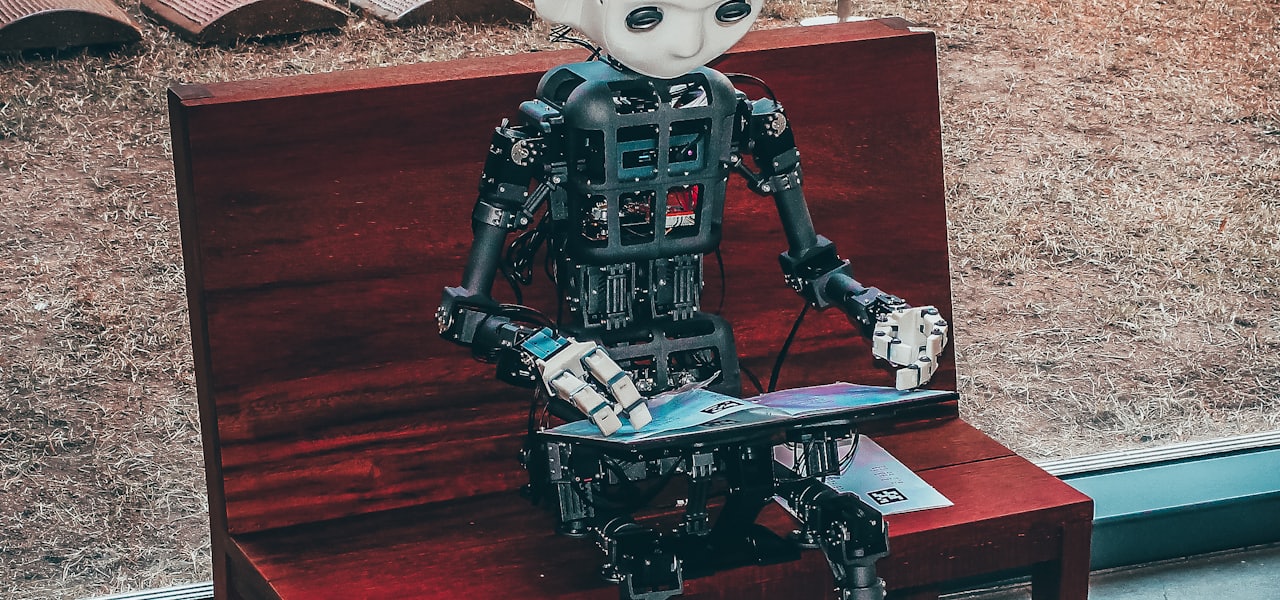
Evolutionary robotics is an embodied approach to Artificial Intelligence (AI) in which robots are automatically designed using Darwinian principles of natural selection. The design of a robot, or a subsystem of a robot such as a neural controller, is optimized against a behavioral goal (e.g. run as fast as possible). Usually, designs are evaluated in simulations as fabricating thousands or millions of designs and testing them in the real world is prohibitively expensive in terms of time, money, and safety. An evolutionary robotics experiment starts with a population of randomly generated robot designs. The worst performing designs are discarded and replaced with mutations and/or combinations of the better designs. This evolutionary algorithm continues until a prespecified amount of time elapses or some target performance metric is surpassed. Evolutionary robotics methods are particularly useful for engineering machines that must operate in environments in which humans have limited intuition (nanoscale, space, etc.). Evolved simulated robots can also be used as scientific tools to generate new hypotheses in biology and cognitive science, and to test old hypothesis that require experiments that have proven difficult or impossible to carry out in reality. == History == In the early 1990s, two separate European groups demonstrated different approaches to the evolution of robot control systems. Dario Floreano and Francesco Mondada at EPFL evolved controllers for the Khepera robot. Adrian Thompson, Nick Jakobi, Dave Cliff, Inman Harvey, and Phil Husbands evolved controllers for a Gantry robot at the University of Sussex. However the body of these robots was presupposed before evolution. The first simulations of evolved robots were reported by Karl Sims and Jeffrey Ventrella of the MIT Media Lab, also in the early 1990s. However these so-called virtual creatures never left their simulated worlds. The first evolved robots to be built in reality were 3D-printed by Hod Lipson and Jordan Pollack at Brandeis University at the turn of the 21st century.